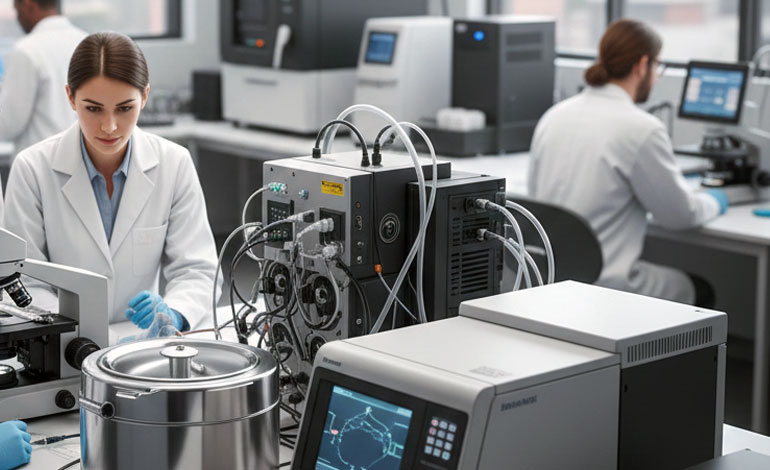
The journey from a ground-breaking scientific idea to a viable biotech company is fraught with challenges, not least of which is the monumental cost and logistical complexity of establishing a functional laboratory. For start-ups operating on lean budgets, acquiring essential, high-caliber equipment is often a prohibitive barrier to entry. This critical need is where biotech incubators and accelerators step in, serving as vital catalysts for innovation. By providing shared access to sophisticated instrumentation and infrastructure, these hubs democratize the tools of discovery, transforming a capital-intensive necessity into an operational expense and allowing nascent companies to focus their precious resources on research and development instead of massive upfront investments.
The Core Pillars of Discovery: Non-Negotiable Equipment
Every wet-lab biotech Startup, regardless of its specific focus, is built upon a foundation of essential equipment. This includes fundamental workhorses like ultra-low temperature freezers (-80°C) for preserving sensitive biological samples, refrigerators and incubators for growing cell cultures at controlled temperatures and CO₂ levels, and biosafety cabinets which provide a sterile environment for handling biological materials, protecting both the experiment and the researcher. Furthermore, basic analytical tools such as microscopes, centrifuges for separating sample components, pipettes for precise liquid handling, and autoclaves for sterilizing equipment are indispensable. Without this core suite of instruments, even the most brilliant scientific concept cannot be empirically tested or developed.
The High-Cost Hurdle: Specialized and Analytical Instruments
Beyond the foundational tools, progress in modern biotechnology demands access to highly specialized and often extraordinarily expensive analytical instruments. These include devices like PCR machines for amplifying DNA, flow cytometers for analyzing cell characteristics, high-performance liquid chromatography (HPLC) systems for separating and identifying complex mixtures, and mass spectrometers for determining molecular structures. Individually, these machines can cost hundreds of thousands of dollars, placing them far beyond the reach of a bootstrapped Startup. This creates a significant innovation valley—a point where a company’s progress stalls because it cannot afford the necessary technology to advance its pipeline, conduct crucial assays, or generate validating data for investors.
The Incubator Model: Shared Access as a Strategic Solution
Biotech incubators directly address this financial impediment through a shared-resource economic model. Instead of each Startup purchasing its own multi-million-dollar suite of equipment, the incubator centralizes these capital costs. It establishes a core facility within its shared laboratory space that is stocked with both essential and advanced instruments. Member companies then gain access to this equipment through a variety of flexible arrangements, such as membership fees, pay-per-use credits, or allocated time slots. This model transforms a massive capital expenditure (CapEx) into a more manageable and predictable operational expenditure (OpEx), dramatically lowering the financial barrier to entry and allowing start-ups to allocate their limited funding toward hiring talent and conducting critical experiments.
Beyond Hardware: The Added Value of Incubator Infrastructure
The value proposition of an incubator extends far beyond merely providing hardware. These ecosystems offer a comprehensive support structure that is equally critical for a Startup’s survival. This includes maintaining and calibrating the complex equipment, ensuring regulatory compliance and safety standards are met, and providing training for researchers on how to operate sophisticated machinery correctly. Furthermore, incubators foster a collaborative community where start-ups can share knowledge, troubleshoot problems, and even form partnerships. This holistic environment of shared resources, expertise, and networking opportunities significantly de-risks the early stages of a biotech venture, accelerating its path from concept to proof-of-concept and, ultimately, to a marketable product.
Conclusion
In conclusion, the high cost of essential and advanced laboratory equipment remains one of the greatest obstacles for biotech start-ups aiming to turn scientific potential into commercial impact. Biotech incubators help dismantle this barrier by transforming critical infrastructure—from ultra-low freezers to PCR machines—into shared, affordable resources. By converting capital-intensive investments into scalable operational expenses, they not only level the playing field but also reduce the time and risk associated with setting up a functional lab.
Yet the impact of incubators goes far beyond equipment access. Through integrated support services—such as regulatory guidance, technical training, equipment maintenance, and built-in collaborative networks—incubators create an environment where early-stage companies can thrive. They accelerate the journey from discovery to development, enabling start-ups to focus on generating meaningful data, attracting investors, and achieving proof-of-concept milestones faster. In an industry where time, precision, and capital are critical, biotech incubators serve not just as cost-saving hubs, but as strategic launchpads for breakthrough innovation. They are indispensable engines in the biotech value chain, helping to translate bold ideas into life-changing solutions for global health and sustainability challenges.
Keywords: Keywords: Biotech startup, lab equipment, incubator, accelerator, shared resource, core facility, capital expenditure (CapEx), operational expenditure (OpEx), ultra-low temperature freezer, biosafety cabinet, cell culture incubator, centrifuge, autoclave, PCR machine, flow cytometer, HPLC, mass spectrometer, infrastructure, proof-of-concept, innovation ecosystem
Written by Crem Co Labs Content Team